
New Jersey Future Blog
Urban Centers Are Back! In Fact, So Is the Whole State of New Jersey
August 12th, 2025 by Tim Evans
2024 municipal population estimates indicate a return to population growth in urban centers – and in the rest of the state.
Late in the decade of the 2000s, around the time of the Great Recession, New Jersey’s population growth pattern underwent a major shift. After more than five decades of suburbanization, in which most population and employment growth happened on undeveloped land on the urban fringe while most of the state’s urban centers and compact, walkable first-generation suburbs stagnated or lost population, the state’s older centers began growing once again around 2007 or 2008. This new demand for in-town living appeared to be driven largely by the preferences of the Millennial generation, who were rejecting the car-dependent suburbs of their parents’ generation.
The shift towards growth in existing centers continued through the 2010s, to the extent that by 2020, redevelopment had become the new normal. More than ⅔ of all residential certificates of occupancy issued since 2015 have been issued in municipalities that are at least 90% built-out, meaning that most of this growth is being accommodated on land that was previously developed for something else. This allowed the pace of land preservation to outstrip the pace of new land development from 2007 forward.
Then the COVID-19 pandemic hit, and several factors seemed to conspire against urban areas. Some people “panic-moved” away from densely populated cities out of fear of viruses spreading quickly where people are closer together. Many young urbanites, with social distancing suddenly rendering them unable to take advantage of the urban amenities that had lured them to the city, chose to move back in with their families. The overnight embrace of remote work inspired some people to turn their vacation homes into their permanent residence, or to move to more remote locations where housing was cheaper.
The death of cities has (once again) been greatly exaggerated
Many of the initial reactions to COVID-19 proved to be temporary. It turns out, those who relocated permanently to more bucolic settings were not particularly representative. And it has become apparent that pundits who predicted an urban doom loop had rushed to premature conclusions. Nationally, many cities are now reversing the population losses they sustained during the pandemic years. According to the Census Bureau, “Cities in the Northeast that had experienced population declines in 2023 are now experiencing significant population growth, on average. In fact, cities of all sizes, in all regions, showed faster growth and larger gains than in 2023, except for small cities in the South, whose average population growth rate remained the same.”
The return to growth in walkable centers is visible in New Jersey, no matter how you look at it. The two big cities that bookend the state—New York City and Philadelphia—both lost substantial population for the two years between 2020 and 2022 (and Philadelphia lost an additional smaller number between 2022 and 2023), erasing some of the gains they had realized during the urban resurgence of the 2010s. However, in both cases, they have returned to pre-COVID patterns, with their numerical increases between 2023 and 2024 actually exceeding their average annual gains between 2010 and 2019.

Almost all of New Jersey’s major cities have more than regained whatever population they may have lost in the wake of the pandemic.
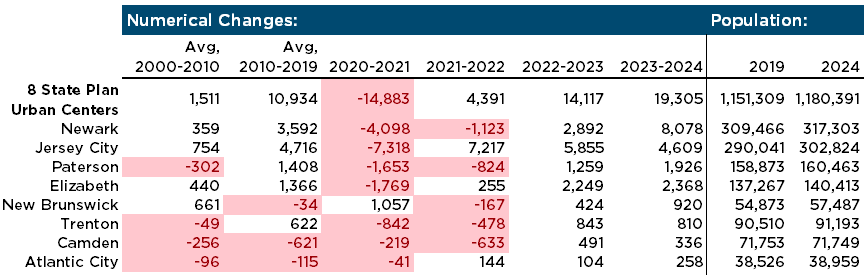
Compact, walkable centers of all sizes are bouncing back post-pandemic
The post-COVID rebound is not just happening in the state’s big cities. In fact, it’s hard to find anywhere in New Jersey that has not grown over the past two years.
Consider the 116 municipalities that score well on all three of New Jersey Future’s municipal smart-growth metrics.1 As a group, these municipalities had been gaining an average of about 28,000 people per year between 2010 and 2019, accounting for more than half of the state’s total population growth over the decade. This represented a dramatic turnaround from prior decades, when walkable centers made up a much smaller share of total statewide growth. These centers suffered a temporary setback as they lost a little more than 33,000 people combined in the first year of the pandemic, from 2020 to 2021, and gained only a modest 5,830 the following year. But between 2022 and 2023, they gained almost 40,000, well above their average from the previous decade. From 2023 to 2024, they gained almost 56,000 people, nearly doubling their 2010-2019 annual average.

The collective rebound of compact, walkable towns is not due to a few dominant municipalities but rather is shared widely across the 116 towns. From 2010 to 2019, 97 of the 116 municipalities gained population. Then, from 2020 to 2021, 80 lost population, and almost half (52) lost population again from 2021 to 2022. But since 2022, nearly all of them have gained population again, with only two losing population over the last year.

Sprawl is making a comeback too
Interestingly, while the high-scoring smart-growth municipalities are growing even more robustly now than in the 2010s, they are no longer accounting for quite as large a share of total statewide growth. This is because New Jersey is growing dramatically faster, in terms of annual increase, over the past two years than in the 2000s or the 2010s. Its growth rate of 1.3% from 2023 to 2024 was the highest in the entire Northeast (including the six New England states and the three Mid-Atlantic states) and enough to land it at #11 nationally, just missing the top 10. New Jersey grew faster in the last year than recent high-profile growth states like Colorado, Tennessee, Georgia, and Virginia.
It’s hard to find anywhere in New Jersey that is not growing over the past two years.
New Jersey’s growth in the last two years is not concentrated in any particular part of the state. Between 2023 and 2024, 532 of the state’s 564 municipalities gained population, and 487 grew between 2022 and 2023, as compared to 352 between 2021 and 2022, and only 286 between 2020 and 2021. Even the most spread-out, car-dependent places—the 164 municipalities that do not score well on any of the three smart-growth metrics—contributed substantially to the state’s growth from 2023 to 2024. Their collective population gain of more than 23,000 over the last year was more than double their annual average gain in the 2000s, and five times their annual increase between 2010 and 2019, when they lagged the rest of the state.
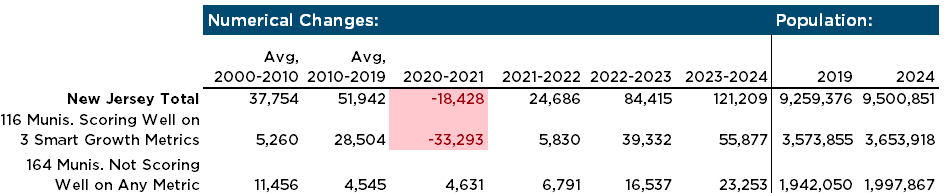
Where will New Jersey’s new residents live?
However, it remains to be seen how long a new round of population growth in New Jersey can last, given that housing supply is still struggling to keep up with demand. The number of residential certificates of occupancy issued annually dropped by half during the Great Recession and has not recovered.
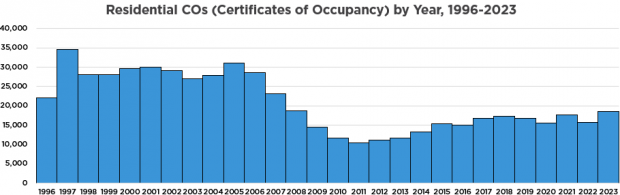
Source: New Jersey Department of Community Affairs, “Certificates of Occupancy Yearly Summary Data”
Lagging housing growth will continue to put upward pressure on both home prices and rents, running the risk of pricing out households of more modest means. Municipalities should take the new rules for complying with affordable-housing obligations under the Mount Laurel doctrine as a cue to examine their housing and zoning policies more generally and holistically. They can then make any changes needed to ensure that they are providing a full range of housing options, so people of all backgrounds and incomes who would like to call New Jersey home in the future can find an affordable home that suits their needs in a safe, healthy, and vibrant community.
New Jersey’s future isn’t written in spreadsheets—it’s built in neighborhoods, around kitchen tables, and in the shared spaces where people gather and grow together. The numbers show we are a state in motion, but the real story is about people seeking a place that feels like home. If we ensure that every corner of New Jersey offers clean streets, safe sidewalks, and homes people can afford, then families of all backgrounds will see what we already know: New Jersey is not just a good place to live, it’s the best. By centering policies on people, we can create vibrant communities where everyone has a fair shot at building a life they love here.
1 The three smart-growth metrics are net activity density (population plus jobs per square mile), presence of a mixed-use “center,” and median block size (a measure of street network connectivity and walkability).
Tags: Affordable housing, cities, Compact development, COVID-19, COVID-19 recovery, Housing, municipalities, Population, population increases, population trends, Redevelopment, Smart Growth, Suburban Sprawl, Urban centers, urbanism, walkability, walkable communities, walkable urbanism