New Jersey Future Blog
New Model Ordinance Will Help Reduce Polluted Runoff in New Jersey
September 4th, 2018 by New Jersey Future staff
The following was written by Becky Hammer, NRDC’s deputy director of federal water policy, and originally appeared on the NRDC blog.
A new model ordinance will help New Jersey communities curb harmful stormwater runoff that pollutes local waterways and contributes to urban flooding.
The model ordinance is a new “action” promoted by Sustainable Jersey, a nonprofit organization that provides tools and training to support communities as they pursue sustainability goals. Under Sustainable Jersey’s sustainability certification program, municipalities undertake voluntary “actions” to earn “points” toward certification.
The model stormwater ordinance, which was developed in collaboration with NRDC, joined the menu of eligible sustainability “actions” last month. Read the rest of this entry »
DOT’s Municipal Aid: Look Beneath the (Re)Surface for Innovative Uses
August 17th, 2018 by Missy Rebovich
Municipal Aid application deadline is October 8.
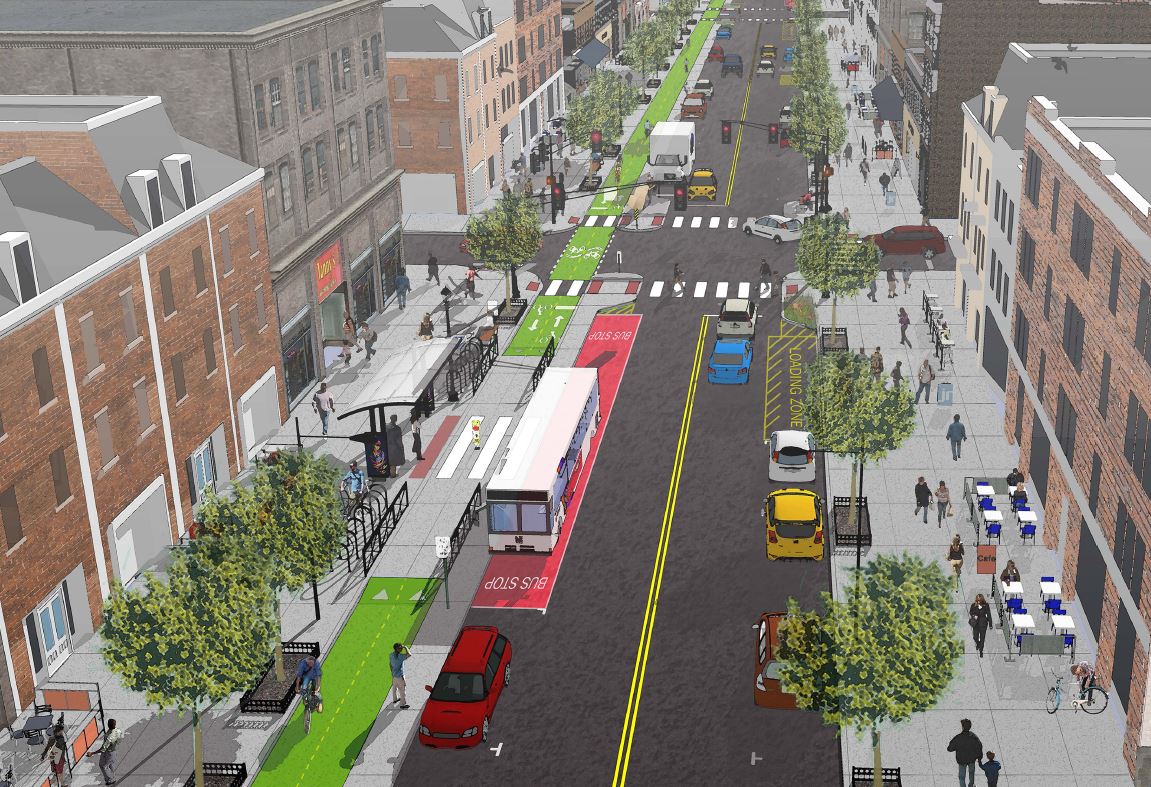
Rendering of an upgraded Washington Street in Hoboken, including planned green infrastructure.
Dear municipalities,
Some of you are leaving money on the table.
The NJDOT’s Division of Local Aid and Economic Development has $115 million to offer municipalities through its Municipal Aid program to support a wide variety of local infrastructure projects. And while the program is often thought of as a resource for road preservation projects such as resurfacing or reconstruction, it can fund a wide array of improvements. Some municipalities may not have thought to envision what they could use the money for, so here are some ideas. Read the rest of this entry »
Are the Suburbs Back? Depends On How You Define ‘Suburb’
August 13th, 2018 by Tim Evans
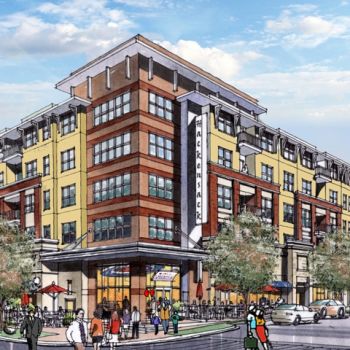
Hackensack: City or suburb? Graphic: DMR Architects
Starting around 2008, demographers, economists, and urban planners started noticing something – long-dormant cities, towns, and older suburbs that pre-dated the automobile era began gaining population again, many for the first time in decades. New Jersey Future commented on this nascent trend as early as 2009 (“Suburbs Still Growing … But So Are The Cities”; “Cities Show Signs of Reversing Trend, Gaining Population”), observing that “several demographic trends may be converging and conspiring to dampen suburban sprawl while fueling the rebirth of cities and older, close-in suburbs.” The proximate cause for the reversal of previous patterns was the Great Recession of 2008, which, combined with $4/gallon gas prices at the time, seemed as if it may have been prompting people to reevaluate their residential locational decisions. Perhaps people were finally questioning the wisdom of the “drive ‘til you qualify” strategy of home buying, wherein one purchases a home of a desired size on a desired budget by looking far enough out on the suburban perimeter to find low enough home prices, and trading the lower home price for a longer drive to work and other regional destinations. Read the rest of this entry »
Combined Sewer Permit Holders Meet Report Deadline
July 25th, 2018 by Moriah Kinberg
NJDEP has posted all required reports on its website, and is inviting public comment
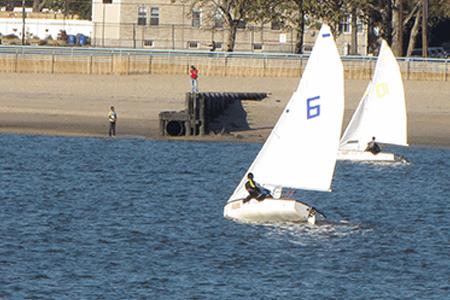
Sailboats near a combined-sewer outfall in Perth Amboy.
New Jersey municipalities with combined sewer systems just got a little closer to reducing the amount of raw sewage being dumped into our waterways. July 1, 2018, marked the end of the first three years of the combined sewer overflow (CSO) permits that were issued to 21 municipalities and four utilities by the New Jersey Department of Environmental Protection (NJDEP). All of the permit holders met the state-mandated deadline for providing reports on the status of their efforts to comply with requirements to address their CSO systems. These reports include: Read the rest of this entry »
Eleven Great One Water Ideas From the Jersey Water Works Membership Meeting
July 24th, 2018 by Elaine Clisham
One Water: the idea that all water, regardless of source or use, has value and should be managed as one cycle looking across economic, social, and ecosystem needs to deliver multiple benefits.
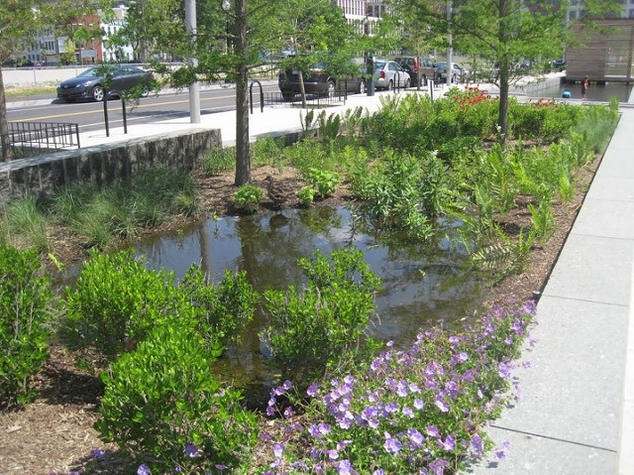
A rain garden at work, holding and infiltrating rainwater after it runs off the pavement, so it doesn’t wind up in the sewer system.
This was the topic of discussion at Jersey Water Works’ July 19 annual membership meeting. Led by longtime Jersey Water Works member Chris Daggett of the Geraldine R. Dodge Foundation, participants went through an exercise at their tables that asked them to talk about a project, either current or upcoming, that exemplified the concept of One Water. What we learned was that there are an enormous variety of projects that exemplify the One Water concept here in the Garden State. Here are several that stood out: Read the rest of this entry »
New Report Highlights Green Infrastructure Financing Opportunities
July 19th, 2018 by Chris Sturm
The New Jersey Water Bank provides very favorable financing for green infrastructure related to CSO abatement projects. So why is gaining access to this financing sometimes a challenge?
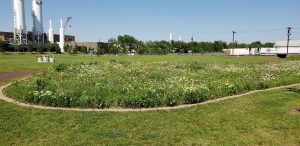
Green infrastructure at Phoenix Park in Camden.
Photo credit: Camden County Municipal Utilities Authority.
New Jersey Future’s new analysis, A Review of New Jersey Water Bank Financing for Green Infrastructure Projects, addresses this question. The report emphasizes the importance of the state’s green infrastructure financing program, particularly for communities with combined sewer systems; describes program accomplishments including green infrastructure projects that took advantage of the Water Bank’s favorable financing and terms; reviews best practices for potential applicants to access financing more successfully; and looks at what the Water Bank is planning to do going forward to make applying for green infrastructure financing even easier. Read the rest of this entry »
DOT Offers Help in Applying for Federal Transportation Grants
May 31st, 2018 by New Jersey Future staff
Safe Routes to School, Transportation Alternatives Set-Aside Funds Available
 The New Jersey Department of Transportation’s Local Aid and Economic Development office is offering 45-minute sessions with representatives of local agencies to help with the federal grant application process. These one-on-one meetings will take place with NJDOT district staff and Metropolitan Planning Organization representatives, with the goal of strengthening Safe Routes to School and Transportation Alternatives Set-Aside grant applications.
Safe Routes to School grants are available for infrastructure projects that encourage and enable students in grades K thru 8 to walk and bike safely to school. Additional information about Safe Routes to School funding, including grant handbooks, screen shots, FAQs and estimates of improvement costs, is available from the the DOT’s website. Transportation Alternatives Set-Aside grants are community-based, non-traditional projects (both land and water) which expand transportation choice, strengthen the economy, improve the quality of life and protect the environment. Additional information and resources regarding these grants are also available on the DOT’s website.
One-on-one meetings will be held from June 11 to 29. Applicants interested in scheduling a meeting should contact the representative from their local DOT district office. These meetings are not mandatory, but they are strongly encouraged to help develop and submit a strong application.
The March Toward Walkable Urbanism Continues
May 25th, 2018 by Tim Evans
State population continues to grow, but slowly
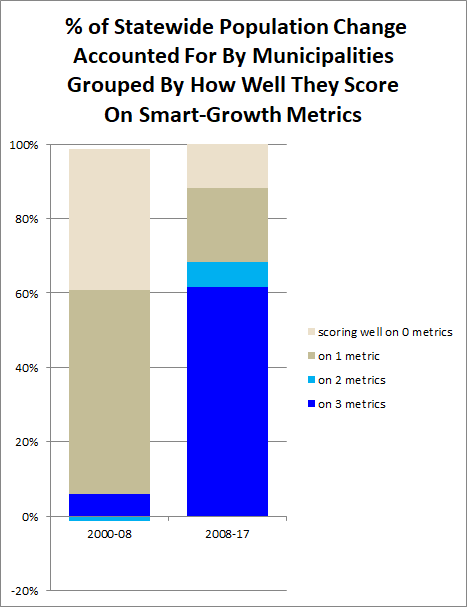 An initial analysis of the Census municipal population estimates released recently confirms that the trend back to walkable urbanism is continuing. An analysis of municipal population changes from 2016 to 2017 against New Jersey Future’s three “smart-growth metrics” — net activity density, presence of a mixed-use “center,” and local street network density — show that as a group, the 124 municipalities that score well on all three metrics grew faster than did the state overall, growing by 0.5 percent compared to 0.3 percent for the state.
These municipalities have accounted for 61.5 percent of statewide population growth from 2008 to 2017, after having accounted for only 6.1 percent of growth from 2000 to 2008. In contrast, municipalities not scoring well on any of the metrics saw their share of growth decline from 38.8 percent for the 2000-2008 period to just 11.9 percent for 2008-2017.
The renewed interest in these places is being fueled by the Millennial generation, who, based on New Jersey Future’s demographic analysis last year, evidenced a pronounced preference for compact, walkable places. As Millennials have entered young adulthood and moved out on their own, they have gravitated toward the state’s cities, smaller downtowns, and older, walkable suburbs.
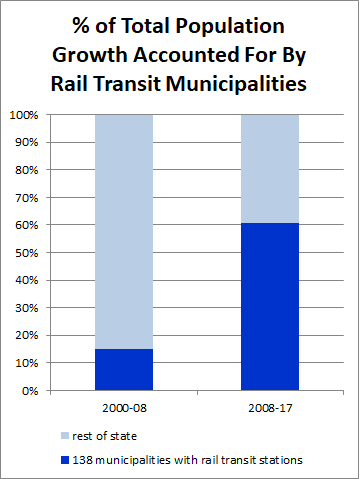 The preference for access to rail transit has also strengthened in recent decades. The 138 municipalities hosting rail transit stations made up 60.8 percent of total statewide population growth between 2008 and 2017, compared to only 14.9 percent between 2000 and 2008. By contrast, municipalities without rail transit service grew by just 2.3 percent from 2008 to 2017, and by 5.4 percent from 2000 to 2008. (This growth around transit underscores the need for New Jersey to make significant investments in transit-oriented development. A bill, A3654/S2333, that would require NJ Transit to establish an office of transit-oriented development, is a good first step.)
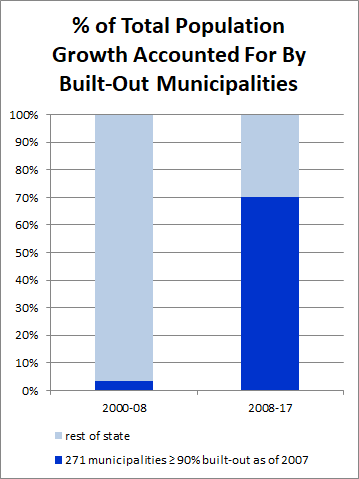 Much of this growth has been happening as redevelopment in already-built places. The 270 municipalities that were at least 90 percent built-out as of 2007 (meaning they had developed at least 90 percent of their total supply of developable land) accounted for 70.1 percent of statewide population growth from 2008 to 2017, compared to a mere 3.6 percent from 2000 to 2008. Redevelopment has become the new normal.
Many of the fastest-growing municipalities so far this decade (2010 to 2017) are places that actually lost population in at least one decade between 1970 and 2010, a period when suburban sprawl and urban disinvestment were at their peak, so the recent turnaround is a remarkable reversal of the broader post-WWII pattern of suburbanization. These revitalizing municipalities include (in descending order of population): Jersey City, Union City, Bayonne, Hoboken, West New York, Bloomfield, Kearny, Fort Lee, Garfield, Princeton, Rahway, Englewood, Cliffside Park, Cranford, Carteret, Lyndhurst, Elmwood Park, Harrison, South Orange, Clark, Weehawken, Fairview, Metuchen, New Providence, Woodland Park, Edgewater, East Rutherford, Wood-Ridge, Kenilworth, Raritan, Fanwood, Allendale, Northvale, and Englishtown. The challenge for these places is how to accommodate the new residents who are seeking the live-work-play environments they offer.
Green Infrastructure Draws Attention at Atlantic Builders Convention
May 16th, 2018 by Louise Wilson
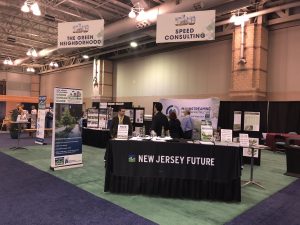
The New Jersey Future/NJBA Green Neighborhood at the Atlantic Builders Convention
The partnership between New Jersey Future and the New Jersey Builders Association – the Developers’ Green Infrastructure Task Force – is nowhere more visible than at the annual Atlantic Builders Convention (ABC) in Atlantic City. This year’s ABC, April 10-12, provided ample evidence that the task force is having an impact. Its members have become enthusiastic, articulate ambassadors for green infrastructure, and more and more developers are actively interested in the broad benefits of designing their projects with GI; they see opportunity rather than risk.
With expanded, highly visible exhibit space; beefed-up educational materials and graphic displays; expert green infrastructure designers on hand providing information and guidance to a steady stream of visitors; “speed consulting” sessions with developers, and a well-attended workshop, New Jersey Future’s Mainstreaming Green Infrastructure program delivered a lot of information to convention-goers: developers, engineers, contractors, architects and landscape architects. Read the rest of this entry »
One Water Awards Nominations Open, Partnership Expands
May 3rd, 2018 by Brian Caycho
 Nominations are open for the second annual New Jersey One Water Awards program, which recognizes integration in water projects and programs. Two additional organizations have become One Water sponsors this year. Together the sponsors represent over 9,000 members each of whom work to advance aspects of integrated water management. Read the rest of this entry »