New Jersey Future Blog
Exploring Green Infrastructure Options for Your Project? These Tools Can Help.
May 1st, 2018 by New Jersey Future staff
This article was written by Elise Eggert-Crowe from Meliora Design, and is derived from a longer report commissioned by New Jersey Future and prepared by Meliora Design.
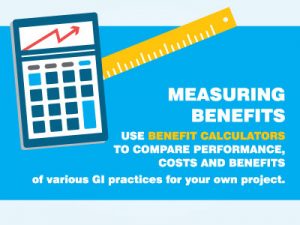 Many tools exist that can help both the technical and non-technical communities understand how green infrastructure practices fit into a development project. While these may not act as a substitute for full design, they can be powerful tools in the site planning process and capture many of the essential components of a site-level design that is required to implement stormwater management.
The following four tools demonstrate green infrastructure options for a development site, which can be especially useful in the planning stage of a project. Many of the tools have overlapping features, which are summarized in Table 1. While all tools provide an overview of the impact of development on stormwater infrastructure, each site is likely to present a unique list of challenges that requires in-depth analysis and expertise.
For those looking for a way to demonstrate green infrastructure options for a development site, consider the benefits of the following tools:
- National Green Values Calculator
This tool was developed by the Center for Neighborhood Technology in collaboration with the U.S. Environmental Protection Agency’s Office of Wetlands, Oceans, and Watersheds. It aligns with methodology used for many regulatory requirements and provides a quick way to compare pre-development and post-development conditions using both conventional and various green infrastructure improvements. Additionally, the tool displays construction costs, maintenance costs, and additional environmental benefits. The National Green Values Calculator appears to be the most useful planning tool for developers, especially in the early project planning stages when decisions are made regarding green versus gray infrastructure. - EPA National Stormwater Calculator
The purpose of this tool, developed by the U.S. Environmental Protection Agency, is to inform the user about how a development project meets a stormwater retention target based on location-specific inputs. The tool is free to use and offers a range of low-impact development practices that the user can model by modifying basic design properties. The tool also offers construction and maintenance cost estimates, which can be useful in informing development design. The tool may be useful for early‐stage planning applications or conceptual‐level site development but is not likely to provide the technical specificity or flexibility that developers would need to implement green infrastructure. - NYC Green Infrastructure Co-Benefits Calculator
The Co-Benefits Calculator is a free tool developed by the New York City Department of Environmental Protection and allows the user to quantify and compare costs and co-benefits of common green infrastructure used in New York City. By altering some parameters, it may be useful outside of New York City. A few examples of co-benefits captured by the tool include increased property value, improved quality of life, carbon sequestration, and supported green jobs. - Autocase
This software was developed with the goal of optimizing lifecycle costs of a project. In focusing on a lifecycle cost analysis that incorporates not only economic but also social and environmental factors, Autocase presents a holistic approach which may help justify the costs of green infrastructure over traditional gray infrastructure. The software allows the user to input site-specific design information and pulls from compiled database information (e.g., Census information, meteorological data, etc.). This software also offers a concise way to communicate the many goals of green infrastructure techniques. The software appears to be helpful mostly to planners or community organizers, since it does not address specific regulatory requirements at the state, county, or municipal level that influence what developers build. Autocase pricing varies depending on license terms; most users pay $5,000 for an annual license.
Common features of green infrastructure tools
| Feature / Tool |
Autocase |
EPA National Stormwater Calculator | NYC Green Infrastructure Co-Benefits Calculator |
National Green Values Calculator |
| Estimates Construction Costs |
● |
● | ● |
● |
| Estimates Maintenance Costs |
● |
● | ● |
● |
| Estimates Economic Costs/Benefits (Beyond Green Feature Installation) |
● |
● |
|
|
| Estimates Environmental Costs/Benefits |
● |
● |
● |
|
| Estimates Social Costs/Benefits |
● |
● |
|
|
| Allows for User-Input Location |
● |
● |
● |
|
| Contains Location-Specific Rainfall/Soil Data |
● |
● |
● |
|
| Contains A Variety of GI Practices |
● |
● | ● |
● |
| Allows for Customization of GI Practices |
● |
● |
● |
|
| Aligns with Regulatory Requirements |
|
● |
||
| Free Tool |
|
● | ● |
● |
You can learn more about each of these tools from the author’s presentation during the “Green Stormwater Infrastructure Consulting: Chat with the Experts” seminar at the Atlantic Builders Convention on Wednesday, April 11, 2018.
About the Author
As a water resources designer with Meliora Design, Elise Eggert-Crowe provides site design, stormwater management design, hydrologic modeling, and permitting services. She is passionate about providing sustainable and effective stormwater management solutions that are integrated cohesively into site design. Elise’s professional experiences include land development plan preparation with a civil engineering firm and stormwater permitting with the City of Philadelphia.
About Meliora Design
An award-winning engineering firm founded in 2007, Meliora Design specializes in civil, structural, and water resources engineering with a focus on sustainable site design and water resources management. Meliora values an integrated design process to reach creative and cost-effective solutions. Meliora Design is a registered Woman’s Business Enterprise (WBE) in New Jersey, Delaware, Georgia, New York, Ohio, and Pennsylvania and the City of Philadelphia.
New Jersey Future Resources Highlighted at National Planners’ Convention
May 1st, 2018 by David Kutner
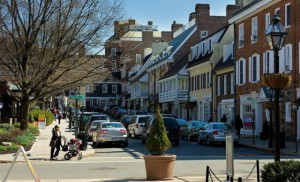
Palmer Square in Princeton. The town is the first in New Jersey to receive the World Health Organization’s Age-Friendly designation.
Several resources developed for New Jersey Future’s work on Creating Great Places To Age were featured at the recent National Planning Conference, the annual convention of the American Planning Association.
At the De-Siloing Age-Friendly Planning Solutions session, a series of best-practice tools and processes were highlighted, including the work New Jersey Future is doing with several communities to evaluate their aging-friendliness and identify opportunities to become more accommodating to older residents. Presenters highlighted the process New Jersey Future has developed and the documents created to support that process, including a letter of agreement that defines the study work scope, establishes a point of contact, and lists the responsibilities of the municipality and project team; draft language for a municipal resolution in support of undertaking a study; and an introductory meeting packet that includes a proposed composition for the municipality’s project steering committee.
Learn more about New Jersey Future’s work on Creating Great Places To Age in New Jersey.
Water Infrastructure a Major Topic at Budget Hearing for DEP
April 26th, 2018 by Brian Caycho
Water infrastructure dominated New Jersey Department of Environmental Protection Acting Commissioner Catherine McCabe’s testimony during the Assembly Budget Committee’s hearing on the agency’s spending blueprint. Lawmakers quizzed McCabe on the state and complexity of the problem, as well as on plans to address it through asset management and other steps recommended by the Joint Legislative Task Force on Drinking Water, including new state revenues. Read the rest of this entry »
Bayonne Water Guardians, Kearny AWAKE and Harrison TIDE Champion Green Initiatives
April 18th, 2018 by Alma Hidalgo
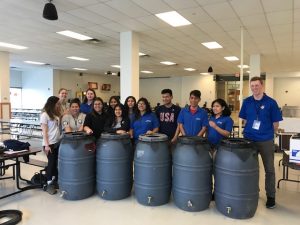
Harrison High School students and New Jersey Watershed Ambassadors with finished rain barrels.
Cities across New Jersey, particularly those with combined sewer overflows (CSOs), are tackling the critical issue of aging water infrastructure. New Jersey’s Department of Environmental Protection issued a permit in 2015 that requires CSO communities to come up with a plan to reduce or eliminate overflows by 2020. New Jersey Future has been working with three CSO communities – Bayonne, Kearny, and Harrison – to implement green infrastructure (GI) practices and environmental education. Green infrastructure practices capture stormwater by mimicking the natural water cycle, preventing it from entering the combined sewer systems and thus reducing overflows.
Each city has created a Municipal Action Team: Harrison TIDE (Transforming Infrastructure and Defending our Environment), Kearny AWAKE (Association of Water, Agriculture And Kearny’s Environment), and Bayonne Water Guardians. Read the rest of this entry »
Opportunity Zones Take Another Step Forward
April 10th, 2018 by Tim Evans
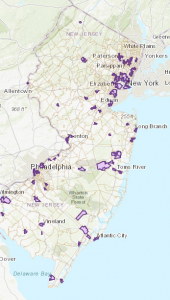
New Jersey’s Opportunity Zones. Click to be taken to the Department of Community Affairs’ interactive map.
On March 10, Gov. Phil Murphy submitted to the U.S. Treasury a list of 169 Census tracts in New Jersey that were being nominated for inclusion in the new Opportunity Zone program. On April 9, the Treasury Department released the full list of approved Census tracts, including all 169 in New Jersey. The full list and an interactive map of these tracts is available on the website of the state Department of Community Affairs.
The Opportunity Zone program was created as part of the recently passed federal Tax Cuts and Jobs Act, and provides a vehicle for private capital investment in “distressed areas.” The program was first proposed in 2015 by the Economic Innovation Group, and was co-sponsored by New Jersey Sen. Cory Booker. Read the rest of this entry »
How Do We Pay for New Jersey’s Aging Stormwater Infrastructure?
April 4th, 2018 by Moriah Kinberg
Tim Filasky
So how do we pay for New Jersey’s aging stormwater infrastructure?
A panel of experts took on this question at New Jersey Future’s 2018 Redevelopment Forum session on the topic. The resounding answer was by allowing for stormwater utilities to be established in New Jersey. According to the 2017 Western Kentucky University Stormwater Utility Survey, there are now 1,639 stormwater utilities nationally, that operate in 40 states. New Jersey does not have a single stormwater utility.
“We have serious stormwater issues, we have those, but we don’t have money.” Senator Bob Smith kicked off the forum session by talking about New Jersey’s stormwater challenges and why they have not been addressed. “Infrastructure doesn’t vote, and does not have a constituency,” he said, but he thinks that the time has come. In January, he introduced Senate Bill 1073, which authorizes municipalities, counties, and certain authorities to establish stormwater utilities. Read the rest of this entry »
A Competition Over Placemaking
April 2nd, 2018 by Elaine Clisham
Forum plenary session addresses what we can learn from Amazon, what are the trends driving economic development around the country, and where New Jersey can focus its efforts. Spoiler alert: It’s about creating great places.
Chris Zimmerman
What are the key things that are driving economic development and growth around the country? During the Redevelopment Forum plenary session, moderator Chris Zimmerman, Smart Growth America’s vice president for economic development, suggested that a quick look at what Amazon is seeking can help answer that. Read the rest of this entry »
Maximizing the Impact of Public-Private Partnerships
March 30th, 2018 by New Jersey Future staff
This article was written by Elsa Leistikow, a recent graduate of The College of New Jersey with a major in sociology and a minor in public policy.
 “Public-private partnerships are not free money.”
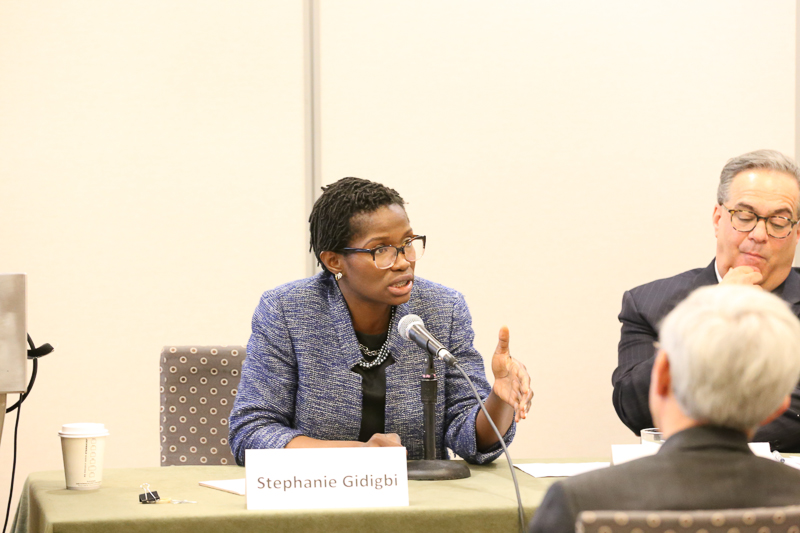
That’s the first point Stephanie Gidigbi, director of NRDC’s Strong, Prosperous and Resilient Communities Challenge (SPARCC), made in the Power of P3s session at New Jersey Future’s 2018 Redevelopment Forum.
Her comments were met with broad concurrence from the rest of the panel, including Dawn Zimmer, former mayor of Hoboken, and Chris Paladino, president of the non-profit New Brunswick Development Corporation. Although these partnerships might look like a panacea to cash-strapped municipalities, Gidigbi emphasized, P3s are not mechanisms for free outsourcing from the private sector. As in any redevelopment project or social service delivery program, aligning conflicting incentives among municipalities, developers, and financiers to deliver a focused, effective outcome is a challenging process. Read the rest of this entry »
Making New Jersey’s Communities More Aging-Friendly
March 29th, 2018 by David Kutner
New Jersey Foundation for Aging’s Melissa Chalker
Land use characteristics that make a community inviting to older people are the same “smart growth” features that are appealing to all populations. These features – readily accessible, center-based locations that offer jobs, housing, entertainment, and amenities – characterize those places that Census data and research show are attracting growing populations of both Millennials and people 55 years of age and older. If New Jersey, ranked 10th in the nation for the number of residents age 60 and older, is going to retain and enhance its economic vitality and viability, its communities will need to recast land use regulations in order to enhance their aging-friendly characteristics.
The Aging-Friendly Is Everyone-Friendly session at New Jersey Future’s annual Redevelopment Forum explored how New Jersey’s changing demographics affect municipal economies; what makes a community aging-friendly; how communities can adjust to the evolving needs of their populations in order to enable residents to age in place; what benefits are gained by creating places that attract multi-generational communities; and how aging-friendly strategies differ for New Jersey’s varying community types. The presentations emphasized the considerable effort that will be required at both the local and state levels to accelerate systemic changes in New Jersey’s development patterns in order to keep pace with the needs of an older population that is growing rapidly and living longer. Read the rest of this entry »
Survey: New Jersey Residents Name Clean Drinking Water as Top Environmental Priority
March 28th, 2018 by New Jersey Future staff
Results also highlight concern about the condition of water infrastructure and willingness to support investment in upgrades
This article was written by New Jersey Future Program Manager Ed DiFiglia and New Jersey Future Community Outreach Coordinator Mo Kinberg.
 New Jersey Future and Jersey Water Works have released the results of a survey of 1,175 New Jersey residents conducted in November 2017 that indicated that New Jersey residents believe securing clean, safe drinking water should be the top environmental priority for the new governor and Legislature. Among the respondents, 40 percent rated “protecting our drinking water” as their main environmental concern.
The survey results also revealed New Jersey residents’ interest in additional investments in water infrastructure, with 90 percent saying that it’s either important or a top priority. Read the rest of this entry »