
New Jersey Future Blog
Leaders From 34 Municipalities Learn About Green Infrastructure
May 17th, 2016 by Kandyce Perry

Attendees from the Pinelands workshop look at a local map and discuss problem spots or barriers, and identify places where green infrastructure opportunities could be explored.
As part of New Jersey Future’s effort to mainstream green infrastructure across the state, it recently conducted two workshops for municipal leaders. The goal for these workshops—conducted in partnership with ANJEC, the Association of New Jersey Environmental Commissions—was to educate local leaders from regions of critical importance to statewide water resources, giving them the knowledge and tools they need to identify opportunities for green infrastructure in their towns and to influence municipal decision making. Mayors, councilmembers, and members of local planning and zoning boards, environmental commissions and green teams, from a total of 20 northwest New Jersey towns and 14 towns in the Pinelands region, attended.
The first workshop, on April 27, in Hopatcong was led by Michele Adams, president of Meliora Design, and Tavis Dockwiller, cofounder of Viridian Landscape Studio (presentation). The second workshop, on May 3 in Egg Harbor Township, was led by Geoff Goll and Jessica Jahre of Princeton Hydro (presentation). Read the rest of this entry »
Infrastructure Matters
May 16th, 2016 by Elaine Clisham
New Jersey Future is participating again this year, along with hundreds of other groups around the country, in Infrastructure Week 2016, to raise awareness about the need to invest in infrastructure as the backbone of our economy, locally and nationally.
 Infrastructure matters, in countless ways large and small, to our economy, our quality of life, our health and safety, and the vibrancy of our communities. Infrastructure matters to companies that manufacture and ship goods, especially in our region, where 40 percent of the country’s population is within a day’s drive. It matters to our daily commutes and our summer vacations. Infrastructure determines if we can drink water straight from our taps and flush our toilets or do our laundry, or enjoy a meal at a restaurant. Ultimately, infrastructure matters to every aspect of our daily lives.
Despite its importance, we seem to accept crumbling infrastructure as the norm: Our bridges need repair, our potholes need filling, our transit service is increasingly unreliable and approaching capacity, and our water pipes can’t handle the demands placed on them. We complain about, but are not willing to spend the funds to fix, any of these problems. Read the rest of this entry »
Fifteen Years of Smart Growth Success
May 13th, 2016 by Lauren Bolline
 For the past 15 years, New Jersey Future has been shining a light on New Jersey’s most innovative plans, policies, and development and redevelopment projects through its Smart Growth Awards. Selected with the support of an independent jury of professional developers, architects, planners and local officials, each nomination is reviewed, visited and evaluated against smart-growth principles as well as its contribution to the surrounding community and the state as a whole.
To date, New Jersey Future has recognized 102 projects and 260 organizations with Smart Growth Awards — 44 organizations of which have been honored more than once. Read the rest of this entry »
Chuck Marohn on the Value of Roads, Streets, and People
May 4th, 2016 by Tim Evans
“Pedestrians are the indicator species of success” for a downtown and its main street. This is how Chuck Marohn, founder of the nonprofit group Strong Towns, speaking at a recent event cosponsored by New Jersey Future and the North Jersey Public Policy Network, summed up why it’s counterproductive to treat a street like a road, and reminded his audience of the difference between the two. Roads are for connecting one place to another; streets are for creating value within a place, by serving as the organizing framework for the assortment of destinations that will attract people (and their disposable income). The more people you have, he argued, the more successful a place is. Read the rest of this entry »
Jersey Water Works Releases 2016 Workplan
April 27th, 2016 by Chris Sturm
Focus areas include improving water system efficiency and engaging community members in water-infrastructure investment decisions

Jersey Water Works committee members finalizing the 2016 work plan.
Jersey Water Works, the cross-sector collaborative formed to address the problems of New Jersey’s aging urban water infrastructure, today released its workplan for 2016. Read the rest of this entry »
Forum Roundup: The Triple-Bottom-Line Beauty of Green Infrastructure
April 19th, 2016 by Kandyce Perry

L to R, panelists Russ Dudley, Tetra Tech; Michele Adams, Meliora Design; Eric Rothman, HR&A Advisors, Inc.; Christopher Franklin, Brandywine Realty Trust; Matthew Testa, Bijou Propoerties
With a room filled to capacity, the Triple-Bottom-Line Beauty of Green Infrastructure panel session at Redevelopment Forum 2016 provided a refreshing response to the looming realities of climate change heard in the opening plenary session. Why? Because green infrastructure can help mitigate some impacts of climate change.
The goal of green infrastructure (GI) is to manage stormwater by enabling it to infiltrate into the ground where it falls or by capturing it for later reuse. This approach improves environmental quality by reducing or preventing runoff, sequestering carbon dioxide, reducing heat island effect, filtering contaminants to improve water quality, and recharging groundwater. Read the rest of this entry »
Demand for Transit Neighborhoods on the Rise
April 18th, 2016 by Tim Evans
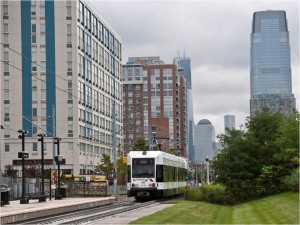
Housing near a Hudson-Bergen Light Rail station in Jersey City. Photo courtesy of NJTPA.
Since 2008, much attention has been devoted in the national and academic presses to the way that the Great Recession and its attendant housing market crash, $4-per-gallon gas, and the emerging preference of the Millennial generation for “walkable urbanism” have converged to produce a new tide of interest in aging transit neighborhoods, giving many of them a second wind. But is this phenomenon actually borne out by data? Or is it just anecdotal evidence, wishful thinking on the part of smart-growth advocates? Read the rest of this entry »
Case Study: How Bioswales Are Helping To Clean Brooklyn’s Gowanus Canal
April 11th, 2016 by Kevin Burkman

Photo credit: Kevin Burkman
Bioswales have become a key tool in urban green infrastructure. These features, comprising soil, rocks, and living vegetation, are designed to absorb and slow down storm runoff from streets, parking lots, and other impervious surfaces. Generally located at street gutter and drain sites, bioswales also capture silt and pollution from the runoff stream. More importantly, in cities with older sewer infrastructure, bioswales help to reduce the amount of runoff water entering the sewage-treatment system, lowering the risk of raw-sewage overflows into local, fragile waterways. One community that has embraced bioswales in its street infrastructure is the post-industrial neighborhood of Gowanus in Brooklyn, N.Y. Read the rest of this entry »
Forum Feature: We Need To Do Transportation Planning for People, Not Cars. And We Need To Do It Fast.
April 6th, 2016 by Elaine Clisham

Gabe Klein at the 2016 Redevelopment Forum.
In his keynote remarks at New Jersey Future’s annual Redevelopment Forum, urban innovator and transportation expert Gabe Klein, author of Start-Up City: Inspiring Private and Public Entrepreneurship, Getting Projects Done, and Having Fun, urged planners and policymakers to rethink completely how they approach the relationship between transportation and place. Despite what we may have been told, he said, the goal of transportation should be not moving people safely, but rather bringing people to places where they want to stay. And too often, he said, places that have been designed around cars are merely places we want to drive through. Read the rest of this entry »
Forum Roundup: Gateway Tunnel Will Provide Much-Needed New Transit Capacity
April 4th, 2016 by Tim Evans

Panelists Tom Wright, Adrian Mapp and Thomas Kean Jr. at the Redevelopment Forum’s session on the Gateway Tunnel
New Jersey’s transit network is one of the keys to the state’s success, facilitating access to New York City’s thriving job market for tens of thousands of New Jersey residents, noted Tom Wright, the President of the Regional Plan Association, at New Jersey Future’s March 11 Redevelopment Forum. But our rail transit system is bumping up against capacity constraints. If we want to continue increasing the number of people who get to work by transit – and to continue creating more transit-oriented neighborhoods for those commuters to live in – we need to expand the number of trains the system can accommodate. Read the rest of this entry »