
New Jersey Future Blog
Research Reveals Recession’s Leveling Effect on Residential Development
October 6th, 2015 by New Jersey Future staff
This article was written by New Jersey Future intern Harrison Blackman, who did the underlying data analysis.
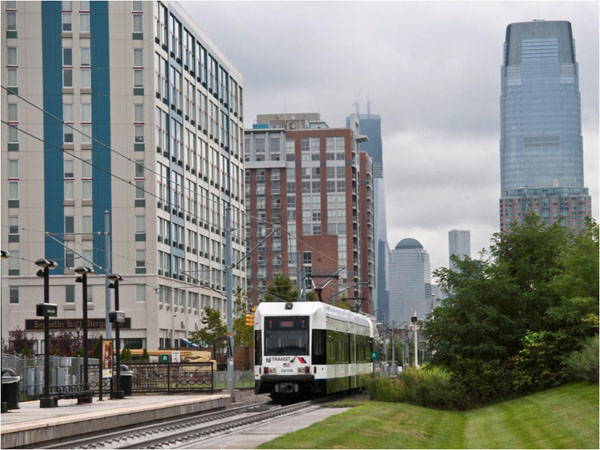
Housing near a Hudson-Bergen Light Rail station in Jersey City. Photo courtesy of NJTPA.
Much has been made of the slowdown in residential development in the wake of the 2008 financial meltdown and the ensuing Great Recession. At the same time, many commentators have noted the growing popularity of mixed-use, walkable urban areas among members of the rising Millennial generation.
Results from recent research appear to reaffirm both these narratives. The research suggests that while less built-out places grew more rapidly than highly built-out places before the recession (as measured by issuance of certificates of occupancy), the two types of places are now growing at similar rates. That is, redevelopment is now keeping pace with “greenfield” development. Read the rest of this entry »
Post-Recession, Housing Growth and Value in Distressed Municipalities Keep Pace With Non-Distressed
October 5th, 2015 by New Jersey Future staff
This article was written by New Jersey Future intern Harrison Blackman, who did the underlying data analysis.
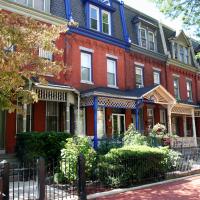
Cooper Plaza Homes in Camden.
In 2006, the Housing and Community Development Network of New Jersey released a report titled Cities in Transition: New Jersey’s Urban Paradox, in which it examined 30 urban communities in New Jersey that it characterized as “distressed,” based on a number of socioeconomic indicators. The economic landscape has changed a great deal since 2006, especially in the wake of 2008’s Great Recession and the resurgence of growth in many urban areas. So how have these distressed communities fared since the start of the 21st century?
Analysis using data on residential values from the New Jersey Legislative Data Book and data on residential certificates of occupancy (COs) from the New Jersey Department of Community Affairs for the years 2000 through 2013 found that distressed, highly built-out communities have kept pace with the CO growth of all highly built-out communities in the state. This research suggests that residential growth in New Jersey in the wake of the recession has been shared more evenly by all municipalities, even if they are considered distressed. Moreover, among only the predominantly built-out municipalities (those that had developed at least 90 percent of their developable land as of 2002), the analysis shows the distressed places grew in value at a slightly higher rate than the non-distressed places. This suggests that, rather than being left behind by the post-recession renewed interest in urban living, distressed municipalities are in fact bouncing back at a greater rate than their non-distressed built-out neighbors. Read the rest of this entry »
Housing and Community Development Network Honors New Jersey Future With Community Partner Award
September 24th, 2015 by Elaine Clisham
 The Housing and Community Development Network of New Jersey announced on Sept. 22 that it will award New Jersey Future its Exceptional Community Partner award. According to the Network, the award goes to an organization that works closely with it “to build strong communities and help ensure economic and social justice.”
In making the award announcement, the Network newsletter cited New Jersey Future’s work to foster smart growth and neighborhood revitalization, noting, “New Jersey Future has been a key ally in the fight to protect New Jersey’s fair housing doctrine, especially in Sandy-affected communities.”
“We are very honored to receive this award,” said New Jersey Future Executive Director Peter Kasabach. “We have the greatest respect for all the work the Network does to lift up communities across New Jersey, and it is an ongoing pleasure to work with them on issues about which both organizations care deeply.”
The award will be presented at the Network’s annual Community Development Conference and Membership Meeting Oct. 20. Other award-winners include the boroughs of Somerville and Roselle; Florence and Franklin townships; and Britnee Timberlake, president of the Essex County Board of Chosen Freeholders and founding executive director of Network member Essex Community Land Trust.
Surgeon General’s #StepItUp Campaign Highlights Land-Use Challenges to Regular Walking
September 10th, 2015 by Elaine Clisham
New Jersey Future resources can help communities evaluate, improve how accommodating they are to pedestrians and cyclists.

Graphic courtesy of Smart Growth America.
New Jersey Future applauds U.S. Surgeon General Vivek Murthy’s Sept. 9 call for people everywhere to walk more — making the strong and obvious connection between land use and our health. In his call to action, Dr. Murthy highlighted walking (or wheelchair rolling) as an easy and low-cost activity that virtually everyone can do frequently, that will have real public-health benefits in the fight against such chronic diseases as diabetes and heart disease.
However, Dr. Murthy acknowledged that there are many places that present significant physical barriers to regular walking, and he called on professionals and citizens across all sectors to work together to reduce those barriers. Read the rest of this entry »
New Jersey Future To Honor George Pruitt, Pioneer in Higher Education, Trenton Revitalization
September 1st, 2015 by Lauren Bolline
 Institutions play an important role in the revitalization of urban downtowns. The city of New Brunswick has anchored its downtown redevelopment around Rutgers University, Johnson and Johnson and two major hospitals. In Trenton, it is Dr. George Pruitt and Thomas Edison State College that are playing a leading role in revitalization.
Dr. Pruitt has been president of Thomas Edison State College since 1982 and has pioneered higher-education investment in Trenton. Deeply committed to New Jersey’s capital city, he has led the college’s effort to restore and construct several historic and new buildings in the city’s downtown, preserving the essence of its stately past and stimulating economic development. These buildings include the Kelsey Building, one of the architectural landmarks of Trenton; the townhouses adjacent to New Jersey’s State House complex; the Center for Learning and Technology; and Kuser Mansion, all on West State Street, as well as the Academic Center and Canal Bank buildings on West Hanover Street. Read the rest of this entry »
New Jersey Future Trustee Gilbert To Receive NJPO Lifetime Achievement Award
August 19th, 2015 by New Jersey Future staff
The following is reprinted with permission from The New Jersey Planner, the official publication of the New Jersey Planning Officials.
 New Jersey Future Trustee Jim Gilbert is this year’s recipient of the New Jersey Planning Officials’ Lifetime Achievement Award.
Mr.Gilbert began his 13-year tenure as chairman of the Englewood Planning Board in 1970, six years before the effective date of the state’s Municipal Land Use Law. In 1981, he assumed a two-year term as president of the New Jersey Federation of Planning Officials. (The organization dropped “Federation of” in a 1994 name change.) Read the rest of this entry »
Entering a New Era of New Jersey Urban Water Quality
August 14th, 2015 by New Jersey Future staff
The first of two updates on the progress being made toward addressing the problem of sewage overflows in New Jersey cities. It was written by New Jersey Future graduate intern Sarah Watson.
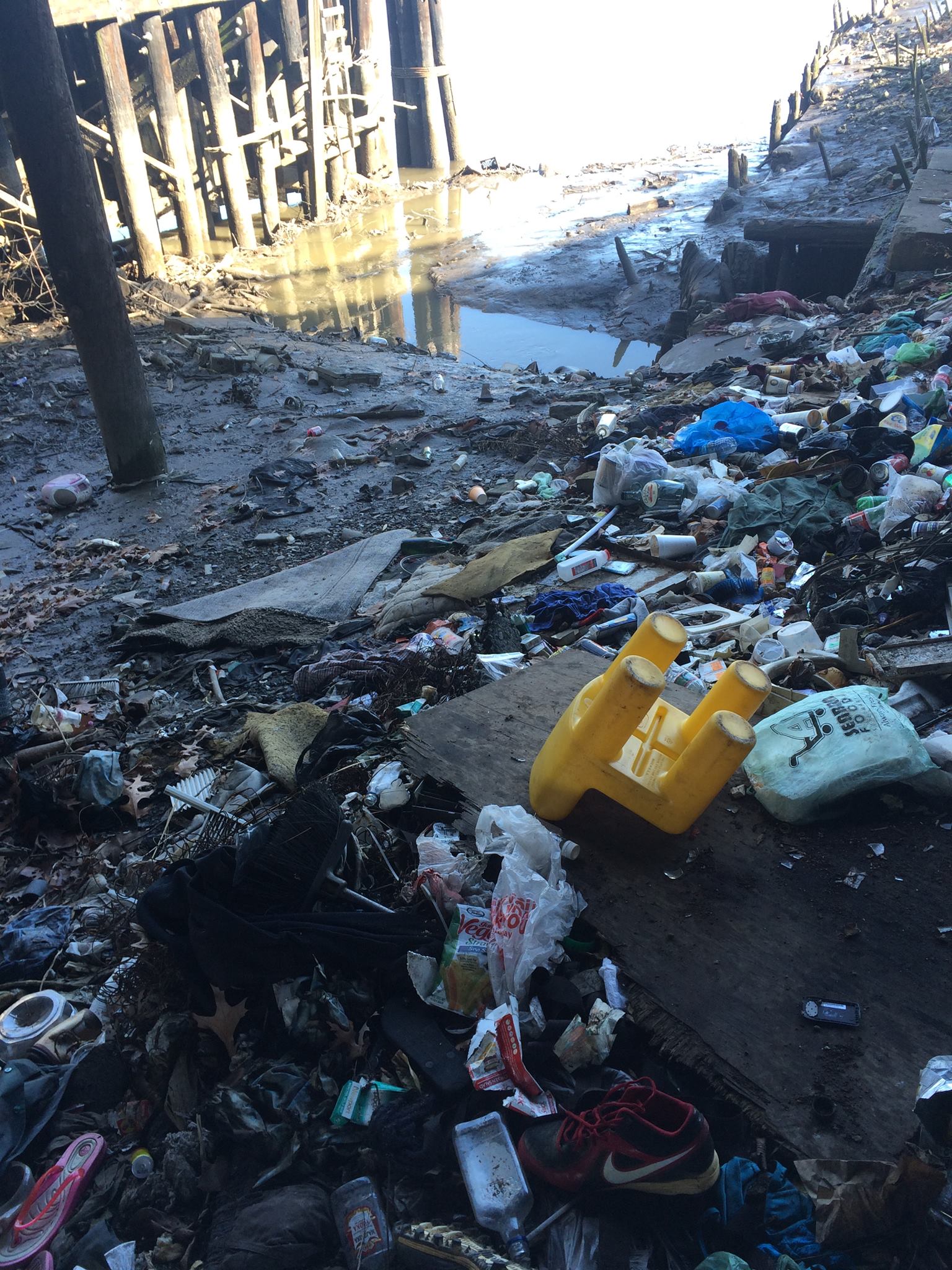
The Jackson Street CSO in Newark
The Passaic Valley Sewerage Commission has signaled that it intends to go above and beyond the minimum requirements set in its new state combined sewer overflow (CSO) permit.
PVSC, three weeks after the CSO permit went into effect, issued a request for proposals for a suite of services that, together, will result in a comprehensive Long Term Control Plan that shows significant forward thinking. The commission stated in its RFP that it “envisions (using) green infrastructure as a key element” of its long term plan, which is required to be complete in five years.
Additionally, the authority wants the experts who help design the plan to incorporate a suite of best practices compiled by the Urban Water Solutions Initiative, a collaborative effort supported by New Jersey Future. Those practices include robust public engagement, water conservation, flooding and climate resiliency measures, regional approaches to solutions and innovative financing. Read the rest of this entry »
Transportation, Housing Improvements Needed To Make New Jersey Towns More Aging-Friendly
August 12th, 2015 by Elaine Clisham
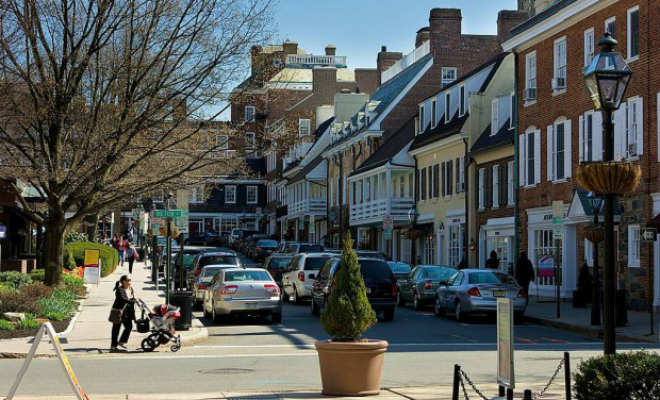
Palmer Square in Princeton. The town is the first in New Jersey to receive the World Health Organization’s Age-Friendly designation.
We came across two items recently that reminded us again that there are some parts of New Jersey that, even though they may have higher-than-average concentrations of older residents, are not particularly accommodating to them from a land-use perspective.
The first item was an article in the national online news publication Vox, and highlights the degree to which most transportation systems fail people who can’t drive. Lack of access to public transit forces people who shouldn’t be driving to do it anyway, even when it’s not safe, or to become increasingly isolated in their homes — a less-than-ideal public health outcome. The article touched on a couple of potential solutions, including the prospect of self-driving cars, but acknowledged that they won’t be able to address the full scale of the problem.
The second item is the recently-launched Livability Index, a product of AARP’s public-policy institute. To use the tool, simply type in the name or zip code of a location, and it calculates an initial index. That number can then be adjusted by indicating the relative importance of each of the factors that went into the initial calculation. So, for example, Manchester Township in Ocean County, which has a very high concentration of older residents but is predominantly single-use and car-dependent residential in character, gets an initial index of 45 out of a possible 100. By contrast, Princeton, which is New Jersey’s first World Health Organization-recognized aging-friendly community and boasts a mixed-use walkable downtown with cultural amenities, comes in with an initial score of 62, and would likely be even higher if the housing stock were more affordable.
The results in New Jersey parallel the findings in a report New Jersey Future released at the beginning of 2014, highlighting the serious mismatch between which towns in the state have higher numbers of older residents and which towns have the most accommodating land-use patterns for those residents.
There are some things any town can do to help solve the problem of stranded older residents. Perhaps the most significant one is to diversify the available housing choices, especially in areas close to amenities such as transit, food, social resources such as community centers and houses of worship, and medical care. Even if good public transit options are not available, having amenities within walking distance of appropriate housing — smaller, with less to maintain — can go a long way toward reducing isolation and increasing physical and psychological health among older residents.
Unfortunately, many municipalities in New Jersey are resistant to the idea of allowing higher-density housing in a mixed-use environment, even though that is where market demand is heading. Municipalities ignore this demand at their peril: As housing options open up elsewhere, older residents will vote with their feet.
Outreach Plan for Hoboken Rebuild By Design Project Needs Improvement
August 4th, 2015 by Megan Callus
 On July 31, New Jersey Future submitted its official comments on the Citizen Outreach Plan portion of Rebuild By Design’s Hudson River project. The proposed plan, developed by the New Jersey Department of Environmental Protection, lays out a process for engaging the public in the design and construction of a massive $230-million flood mitigation project in Hoboken, Weehawken and Jersey City .
New Jersey Future reviewed the plan carefully to see if it would offer the public an opportunity to ensure that the project is truly resilient and equitable. For example: Will the project protect people and property from future floods, even in light of projected sea-level rise? Will the project treat equally those residents who have the most difficulty responding to disasters due to their lack of access to critical resources, limited English proficiency, age, and mental or physical disabilities? And will it complement and advance other community goals for economic development, quality of life and a healthy environment? Read the rest of this entry »
Can Somerset County Attract Millennials?
July 30th, 2015 by Elaine Clisham
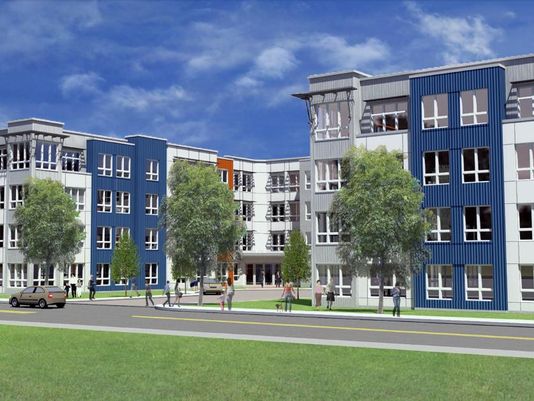
The Cobalt, a proposed apartment development near the Somerville train station. Photo: Weiss Properties
The Fall 2014 Duke Farms studio class at the Edward J. Bloustein School of Planning and Public Policy at Rutgers University had an interesting assignment: Figure out where the opportunities are for Somerset County to attract more Millennial residents. The report, Somerset County Development Opportunities: A Millennial Perspective (pdf), prepared for the Somerset County Business Partnership in collaboration with the Somerset County Freeholders and Planning Board, has now been published. Read the rest of this entry »