
New Jersey Future Blog
New Jersey Future Trustee Ingrid Reed Wins AIA-NJ Award
February 18th, 2015 by Elaine Clisham
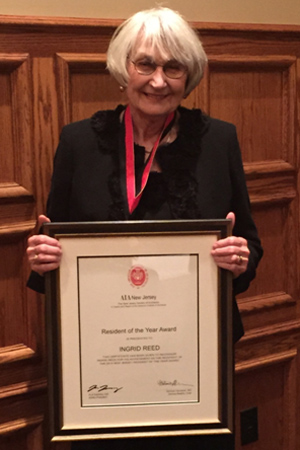 At a ceremony on Jan. 9, the New Jersey chapter of the American Institute of Architects presented the 2014 Resident of the Year Award to New Jersey Future trustee and senior fellow Ingrid W. Reed.
The award recognizes “a person who has made major contributions to the built environment and the quality of life through community activity, legislative involvement, professional (non-architect) practice or by means of other appropriate activities,” says the association. Read the rest of this entry »
Experts Detail Challenges of Adapting to Climate Change
February 17th, 2015 by New Jersey Future staff
New Jersey Future Vulnerability Assessment Process To Be Presented at National Conference
February 6th, 2015 by Elaine Clisham
Methodology quantifies damage and tax-base loss at the parcel level from
sea-level rise and severe weather.
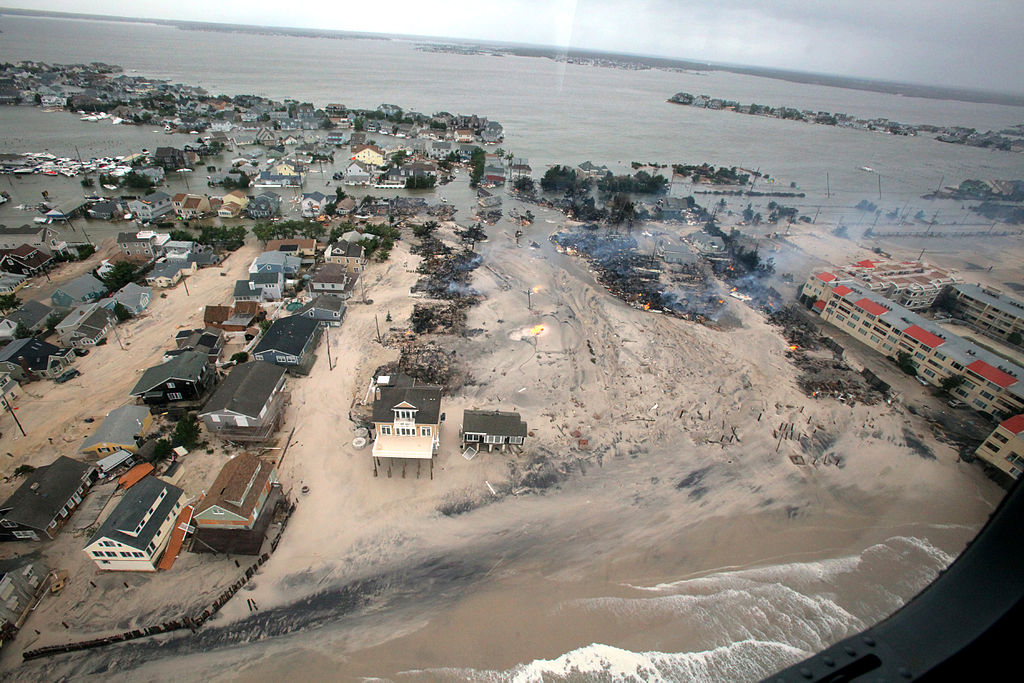
U.S. Air Force photo of Sandy damage to the Jersey Shore.
A new process, developed by New Jersey Future and the environmental engineering firm Princeton Hydro, that calculates a coastal community’s financial exposure to future severe weather and sea-level rise will make its national debut at the American Planning Association annual conference in April 2015.
The vulnerability assessment uses parcel-based maps and data to establish a current baseline high-tide level for a community, and then projects various future extents and depths of inundation from storm surge and sea-level rise. The value of damage to property on each parcel under each scenario is then calculated, and the potential loss to the municipal tax base as a result of that damage is calculated. Read the rest of this entry »
New Jersey Future, Other Groups Urge Veto of ‘Meadowlands Bill’
February 4th, 2015 by Elaine Clisham
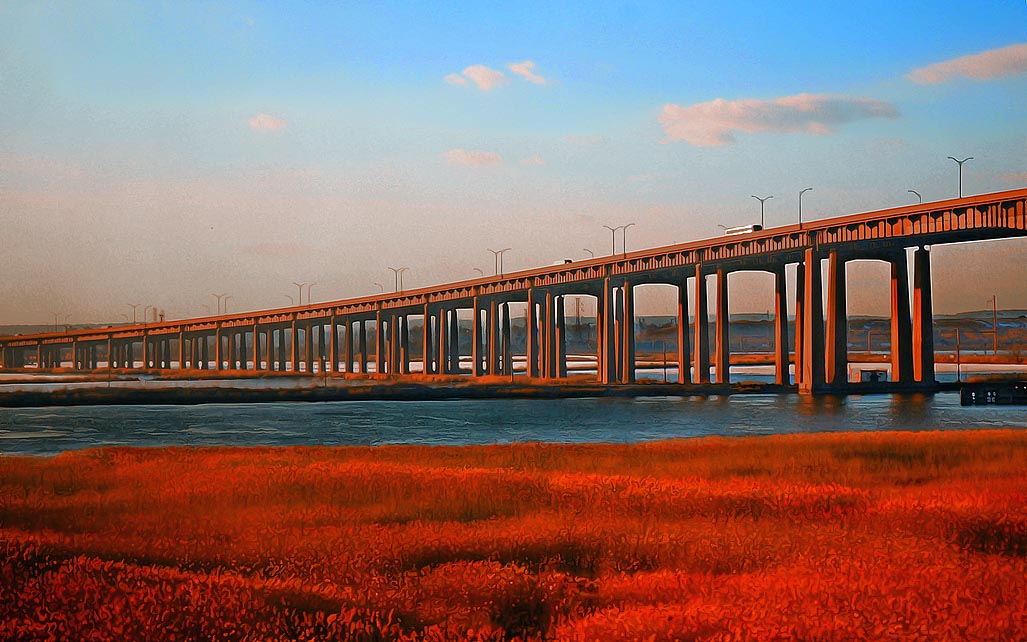
The New Jersey Turnpike as it passes over the Meadowlands. Photo source: flickr user illinigardner
On Jan. 22, 2015, New Jersey Future, along with 10 other partner organizations, filed detailed comments on identical bills A3969/S2647, the so-called “Meadowlands bill,” urging Gov. Christie to veto the legislation and offering to work with the Legislature to craft a bill that would address concerns about current Meadowlands governance without putting past protections and successes at risk.
The groups’ objections to the bill focused on four key concerns:
- The bill would eliminate of one of the most successful examples of regional planning and cooperation in the country. The Meadowlands Commission has been an excellent regional steward, carefully balancing the need for growth and development with the need for conservation and preservation of the environmentally unique and fragile Meadowlands. Now there is no entity responsible for that protection, and the regional tax-sharing arrangement that underlay the commission’s work risks being replaced by public subsidies. For a state that is so concerned about high property taxes, this is exactly the wrong policy direction.
- The bill would open the door to confusing layers of red tape in zoning and development decisions, while not ensuring that development proposals be consistent with the Meadowlands master plan. In fact, the legislation’s wording makes it extremely unclear as to who would have review authority, which creates great uncertainty for those interested in investing and developing in the Meadowlands.
- The bill would put state taxpayers on the hook for subsidizing towns in the Meadowlands. A new hotel tax will generate revenue that in theory will be shared with some of the towns, but if enough money is not generated by the tax, then the state government is required to make up the difference.
- The bill would jeopardize Liberty State Park. The new entity created by the legislation is given authority for planning, implementation and management of projects in the park, and will perhaps even control project approval – again, the legislation is unclear – thus removing control of a state park from the state Dept. of Environmental Protection, which has had, and should rightly have, jurisdiction.
Read the full comments (pdf).
Update: On Feb. 5, 2015, Gov. Christie signed the bill while acknowledging its shortcomings, which the bill’s authors promised to address.
White House Executive Order May Make Shore Communities Less Vulnerable to Storm Damage
February 2nd, 2015 by New Jersey Future staff
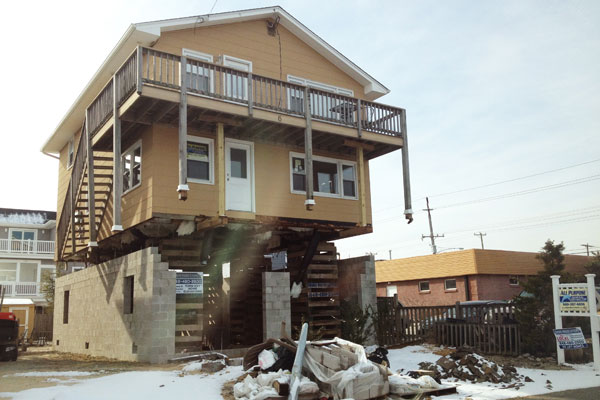
Photo courtesy of NJ Spotlight
President Barack Obama has issued an executive order directing all government agencies handing out federal aid to incorporate stricter building requirements that take sea-level rise into account. The move is aimed at making residents in coastal areas safer from storms like Sandy, as well as ensuring that taxpayer money is spent wisely.
Planners and environmentalists have long lamented that the FEMA flood maps — which dictated the construction standards for Sandy victims rebuilding along the coast — only considered historical flood damage in requiring them to build to the 100-year flood height (a flood that has a 1 percent chance of occurring annually), but did not take into account future risks pertaining to climate change or potentially more severe storms. Most other government agencies similarly failed to incorporate climate predictions in their planning efforts. Read the rest of this entry »
CNU President Is 2015 Forum Keynote Speaker
January 27th, 2015 by Elaine Clisham
 Incoming CNU president Lynn Lynn Richards will be the keynote speaker at the 10th annual Redevelopment Forum. Ms. Richards has been the president and chief executive officer of the Congress for the New Urbanism since July 2014. Previously, Richards had a long and distinguished career at the U.S. Environmental Protection Agency (EPA), holding multiple leadership roles over 13 years including acting director and policy director in the Office of Sustainable Communities. She worked with dozens of state and local governments to implement placemaking approaches by developing policies, urban design strategies, and environmental solutions for vibrant, prosperous neighborhoods. Additionally, she produced groundbreaking research on water and land use strategies. Read the rest of this entry »
Extending Approval for State Plan Centers Could Harm Coastal Towns
January 23rd, 2015 by Megan Callus
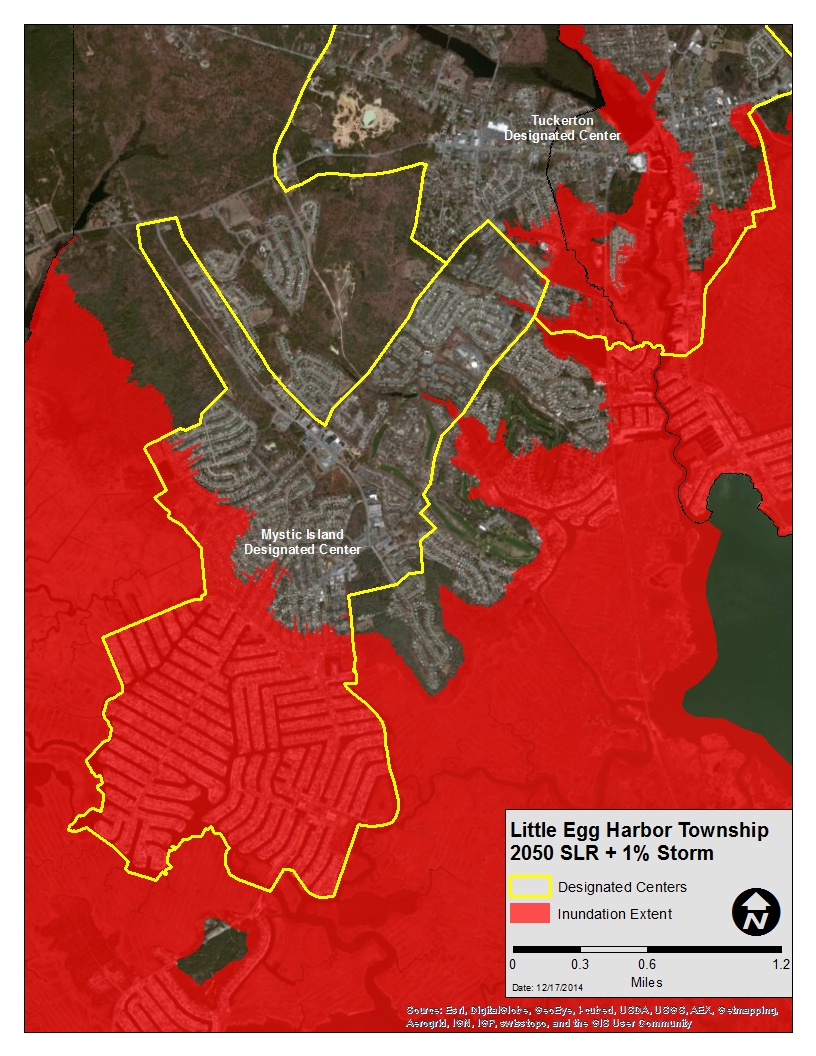
Mystic Island endorsed center projected flooding vulnerability in 2050 under 1-percent storm scenario
On Dec. 18, 2014, New Jersey Future submitted comments (pdf) to the State Planning Commission (SPC) on its proposed Amendment to the State Planning Rules that would extend the period of approvals for any center designations granted by the commission prior to Sept. 6, 2008, by an additional three years beyond their otherwise applicable expiration dates.
Centers were created in the State Plan as a means of identifying areas most suitable for growth, while environmentally sensitive lands are kept protected. The state government provides incentives such as expedited and coordinated permit review to communities that undertake the planning necessary to create centers. Read the rest of this entry »
Rebuild By Design Projects Must Ensure Equity, Resiliency, Public Involvement
January 21st, 2015 by Megan Callus
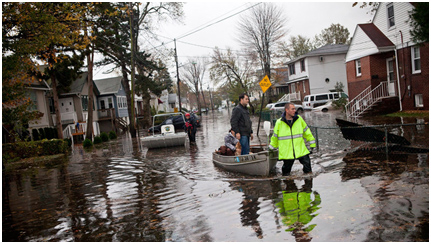
Sandy-related flooding in Little Ferry, a municipality within the New Meadowlands project area. Photo credit: Andrew Burton/Getty Images
New Jersey Future has submitted comments (pdf) on the state’s proposed Amendment 12 to the New Jersey Disaster Recovery Action Plan. This amendment details how the state will spend $380 million in Sandy rebuilding funds to advance two projects selected by the U.S. Department of Housing and Urban Development (HUD) through its Rebuild By Design (RBD) initiative. Rebuild by Design was a design competition of international architects, engineers and planning professionals to generate comprehensive long-term strategies for improving flood resilience in vulnerable communities.
Workshop Attendees Learn Innovative Approaches to Addressing Combined-Sewer Overflows
January 20th, 2015 by Elaine Clisham
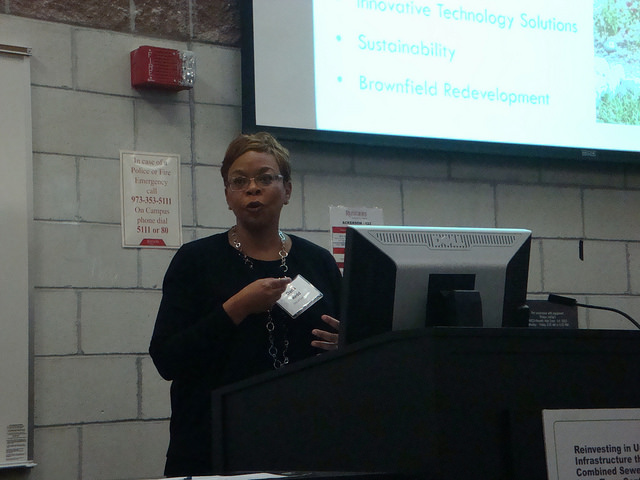
Camden Mayor Dana Redd speaks to attendees at a workshop on addressing combined-sewer overflows.
At a Jan. 8 workshop that focused on ways to solve combined sewer overflow (CSO) problems in New Jersey’s cities, speaker after speaker stressed to attendees the importance of tackling the problem early; of emphasizing the visible benefits of addressing the problem; and of working in tandem with other projects in order to put the most durable and cost-effective solutions in place. Or, as Carter Strickland, the former commissioner of New York City’s Department of Environmental Protection, put it, “Be early. Be opportunistic. Be codependent.” Read the rest of this entry »
New Jersey Future Staff To Speak at APA-NJ Conference
January 15th, 2015 by Elaine Clisham
Documentary film Shored Up to be shown in special screening
 Reflecting the diversity of issues on which New Jersey Future will be working in 2015, its staff will be leading four of the sessions at APA-New Jersey’s upcoming annual conference.
First, on Thursday, Jan. 29, David Kutner, New Jersey Future’s local recovery planning manager, will present a newly-developed interactive mapping tool that can help communities calculate the risk to their tax base of projected sea-level rise. The tool, built in conjunction with Princeton Hydro, can calculate various levels of loss at the parcel level depending on the extent of sea-level rise and storm surge. It has been used in the communities in which New Jersey Future is assisting with post-Sandy planning work as a way of prioritizing recovery and adaptation initiatives, and it can be used in any municipality for initiating the critical but difficult conversation about what must be done differently in the face of rising sea levels. (Assessing Financial Exposure to Sea-Level Rise, Thursday, Jan. 29, 10:45 AM – 12:15 PM.)
On Friday, Jan. 30, Chris Sturm, senior director of state policy, will moderate a panel on best practices in implementing green infrastructure, focused on tools such as model ordinances and innovative financing mechanisms that are designed to advance green infrastructure off the drawing board and into standard stormwater-management practices. Green infrastructure can not only help to manage stormwater but can also serve to create healthier, “green” communities, particularly in more urban locations, and provide much-needed local jobs and public amenities. (Moving Green Infrastructure From “State of the Art” to “Standard Practice,” Friday, Jan. 30, 9:30 – 11:00 AM.)
Also on Friday, Research Director Tim Evans will continue the conversation about creating great places to age in New Jersey that was begun with the publication of last year’s report on the topic. This session will examine which places are already well positioned to accommodate aging residents in terms of community design, accessibility to transit, and choice and affordability of housing, and will review practical steps all municipalities can take to help their residents stay as they age. (Creating Good Places To Age in New Jersey, Friday, Jan. 30, 3:15 – 4:45 PM.)
Friday afternoon, conference attendees are invited to a special screening of the film Shored Up, a thought-provoking, post-Sandy look at issues related to coastal development and coastal flooding from extreme weather in New Jersey and North Carolina. This Sundance award-winning documentary explores the likely impact of sea level rise, the effects on development of federal subsidies for both beach replenishment and flood insurance, and the politics and emotions that surround these topics. More than two years after the storm, these issues remain of critical concern to planners and policy makers. The screening will be followed by a moderated discussion. (Shored Up screening, Friday, Jan. 30, 3:15 – 4:45 PM.)
Finally, please join New Jersey Future at the Old Bay Restaurant in New Brunswick after the conference ends on Friday, for an informal get-together. Meet New Jersey Future staff, New Jersey Future members, and professionals in the field. Even if you’re not going to the conference, please feel free to join us! No charge, cash bar. (Meet and Greet, Old Bay Restaurant, 61 Church St., New Brunswick, 5:00 PM – ?)